For the modern enterprise AI startup, Microsoft Azure’s "Startups Founders Hub" is often viewed as the ultimate launchpad. Offering up to $150,000 in cloud credits, it provides the computational horsepower necessary to build, iterate, and scale. However, a growing number of founders are discovering that the "fine print" of these credits is creating a significant financial chasm, particularly when it comes to utilizing third-party Large Language Models (LLMs).
As recently reported by The Register, Takuya Tominaga, CEO of the Tokyo-based startup Leach, found himself at the center of an expensive billing paradox. After experimenting with Anthropic’s Claude via the Azure AI Foundry—under the impression that his startup credits would cover the costs—he was hit with a $1,600 charge directly to his credit card. His experience highlights a systemic friction point in the "Model-as-a-Service" (MaaS) ecosystem.
The Marketplace Trap
The core of the issue lies in the distinction between first-party Azure services and third-party Marketplace offerings. While Azure credits typically cover "consumption" services like virtual machines, storage, and Microsoft’s own OpenAI deployments, they often do not apply to third-party branded products sold through the Azure Marketplace—even when those products are accessed through integrated platforms like Azure AI Foundry.
Tominaga’s frustration is echoed by other founders who have seen bills as high as $3,000 processed while their six-figure credit balances sat untouched. The primary grievance is not necessarily the charge itself, but the lack of UI transparency.
"The UI makes no distinction between credit-covered and Marketplace-billed models," Tominaga noted, pointing out that the first indication of a problem for many founders is the arrival of a credit card statement.
Conflicting Guidance and the Support Loop
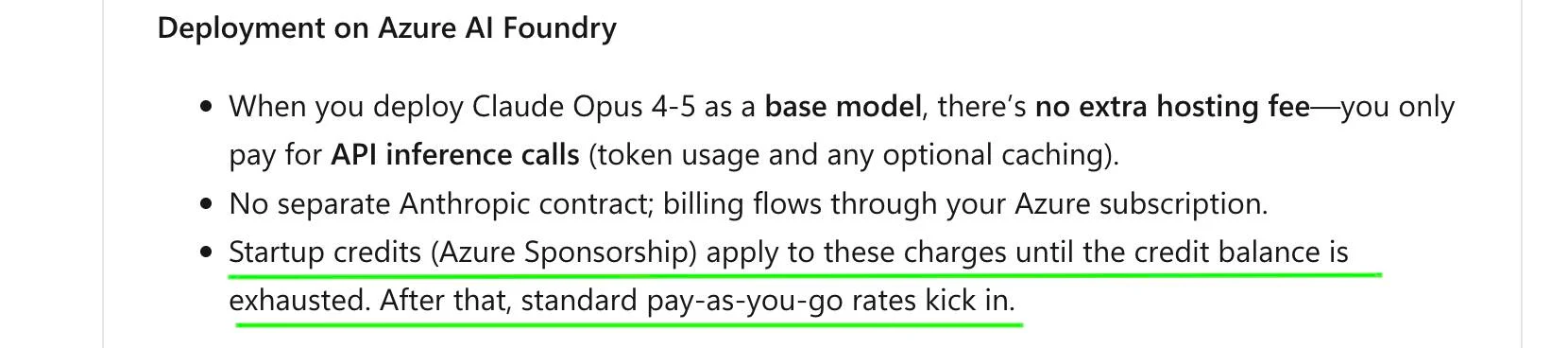
Adding to the confusion is the reliability of technical guidance. In Tominaga's case, a moderator on an official Microsoft forum explicitly stated that startup credits would apply to Claude deployments until exhausted. This advice was later retracted and edited after charges had already been incurred, aligning the stance with official documentation that excludes "third-party branded products" from credit eligibility.
When discrepancies arise, startups find themselves trapped in a "support ticket vacuum." Because the service involves two distinct entities—the cloud provider (Microsoft) and the model provider (Anthropic)—accountability becomes fragmented. Microsoft directs customers to the model creator for refunds, while the model creator claims no visibility into Azure's proprietary billing systems. It is an administrative stalemate that fledgling companies can ill afford.
Key Takeaways for AI Founders:
Verify the Billing Source: Always check if a model is labeled as a "Marketplace" or "Third-Party" offering before deployment.
Isolate Test Environments: Use capped credit cards or strict billing alerts for any experimentation outside of standard Azure OpenAI services.
Documentation Over Forums: Treat any advice from forum moderators or external staff with skepticism; only the formal Terms & Conditions (T&Cs) hold weight in billing disputes.
The Strategic Risk for Cloud Providers
For Microsoft, this is more than a customer service hiccup; it is a branding risk. The value proposition of Azure AI Foundry is its seamless integration of diverse models—from Meta’s Llama to Anthropic’s Claude. If the billing interface fails to reflect the reality of how those models are paid for, it erodes the "platform" advantage Microsoft is attempting to build.
As the AI sector moves toward a multi-model reality, the expectation from developers is clear: unified billing and transparent credit application. Until cloud providers bridge the gap between their promotional credits and their third-party marketplaces, the "free" credits promised to startups may remain a minefield rather than a resource.
Taiken is building financial governance tooling for enterprise AI spend. If you're a CFO or VP of Finance managing material AI budgets, apply for design partnership.